
Clarity in the Cloud: Rapid Fog Testing of Air Barrier Assemblies 1.0 CEU/HSW
November 5 @ 1:00 pm - 2:00 pm EST
Fog testing is a practical and revealing method for verifying air barrier performance in building construction. Traditional fog testing demands three key components for meaningful results: a fog generator, an enclosure to contain and create a pressure differential across the assembly, and a variable speed fan to pressurize the enclosure.
We have streamlined this process by integrating the fog generator and variable speed fan into a single portable machine, which largely eliminates the need for a dedicated test enclosure. This pressurized fog system can easily push fog through a wide range of construction assemblies, enabling early-stage testing and rapid feedback without disruption to subcontractors or schedule. Our methodology works for testing mockups, assemblies at any phase of construction, and in any season of the year. With it, we can assess 8-12 air barrier details or assemblies per day.
This streamlined methodology allows us to verify every critical envelope detail for air tightness when it is first installed so adjustments to design or installation can be made easily before the detail is replicated. This method is especially effective at testing complex and 3-dimensional air barrier transitions. This early feedback makes it easy for project teams to meet stringent air barrier targets and avoid condensation, rot, and rust caused by air leakage.
Beyond its value as a quality assurance measure, our fog testing approach serves as a powerful diagnostic tool for identifying and understanding problematic air leakage pathways in both new and existing structures. Unlike other test methods, fog testing identifies both the entry and exit path of a problematic air leak.
This presentation will demonstrate how the testing works, strengths and weaknesses of the method, and case studies from fifteen years of rapid fog testing in building envelope commissioning and diagnostics.
Learning Objectives:
- Compare the rapid air tightness verification method with other air tightness verification methods
- Describe our rapid fog testing machine and how it works
- Provide case studies with rapid air tightness verification on new construction
- Provide case studies with rapid air tightness testing in diagnosing envelope failures
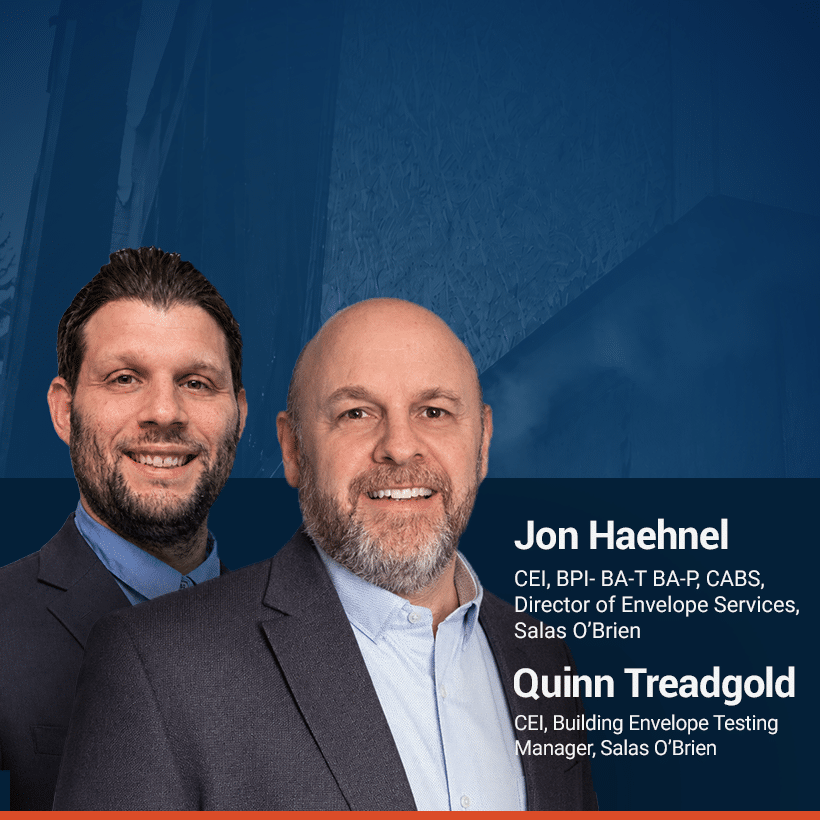
Jon Haehnel, CEI, BPI- BA-T BA-P, CABS, Director of Envelope Services, Salas O’Brien
 Jon Haehnel has been testing and inspecting building envelopes for over 23 years. His expertise in building envelope commissioning and design focuses primarily on institutional and commercial buildings, both new construction and renovation. Jon has commissioned the building envelope on all types of construction: laboratories, clean rooms, indoor pools, hospitals, military facilities, manufacturing, dormitories, high rise construction, and educational buildings. His experience also includes building envelope forensics. Jon is coauthor of “Setting Airtightness Standards” (ASHRAE Journal, Sept. 2005) and has presented on building envelope topics for the Better Buildings by Design Conference, Building Commissioning Association (BECxA), Construction Standards Institute (CSI), American Institute of Architects (AIA), and the American Council of Engineering Companies (ACEC). Jon formerly taught commercial energy auditing and blower door testing at Vermont Technical College.
Quinn Treadgold, CEI, Building Envelope Testing Manager, Salas O’Brien
 Quinn Treadgold has worked in the Building Envelope Commissioning field since 2016, following his graduation from the University of Vermont with a BS in Mechanical Engineering. He previously worked closely with Jon Haehnel at Zero by Degrees, which later merged with BVH Integrated Services and became part of Salas O’Brien. Quinn began his career as a Building Envelope Commissioning (BECx) provider, performing extensive field-based air and water leakage testing and diagnostic services. His strong technical aptitude and construction experience have supported his progression into the role of Building Envelope Testing Manager at Salas O’Brien. Drawing on his engineering background, interest in fluid dynamics, and internship at SOH Wind Engineering, Quinn collaborated with Jon to develop an improved rapid fog testing method for building envelope transitions. This approach has enhanced testing efficiency, enabled more complex conditions to be evaluated, and delivered added value to project teams. The method has helped distinguish the firm within the industry, with the broader goal of advancing building envelope testing practices overall.